How to Clean Your Fridge Before Christmas
How to clean a fridge safely before the Christmas food shop, from glass shelves and door seals to the drain hole, plus when to defrost the freezer.
Read more →
An oven tends to get cleaned when guests are coming, which makes November a popular time to look inside and regret it. The good news is that most ovens respond well to patience and a mild paste. The bad news is that the wrong product can permanently damage parts of the oven, so the first job is finding out what type you have.
Ovens are not all lined the same way, and the right method depends on the interior. If you no longer have the manual, the make and model number is usually printed on a plate around the door frame, and most manufacturers publish their guides online.
Standard enamel interior. A smooth, glossy lining that you clean by hand. The method below is written mainly for this type.
Catalytic liners. Rough, slightly speckled panels, often on the back and sides. They break down grease when the oven runs hot. They mainly deal with fat and grease rather than sugary spills, and the coating is delicate. Do not use oven cleaner, detergent or anything abrasive on them, because the damage can be permanent. Clean only the non-catalytic parts by hand, and use the hot cycle in your manual for the liners.
Pyrolytic ovens. These heat to a very high temperature and reduce residue to ash. Follow the manual closely, particularly on what must be removed first, as racks and accessories often have to come out. Keep the room ventilated, let the oven cool completely, then wipe out the ash with a damp cloth.
Steam or aqua clean settings. These soften light soiling so it is easier to wipe away. They are useful for regular upkeep, but they are unlikely to shift thick, carbonised grease on their own.
Before you start, make sure the oven is switched off and completely cold. Then take out the racks, the trays and any removable side runners.
Racks and trays are easiest to clean while soaking. Put them in a sink or washing-up bowl of hot water with washing-up liquid, and leave them while you work on the interior. If you use the bath, protect it with an old towel first, because metal racks can scratch it.
After soaking, work on them with a non-scratch sponge, then rinse and dry them. Check the manual before you put them through a dishwasher, as not all racks and trays are suitable.
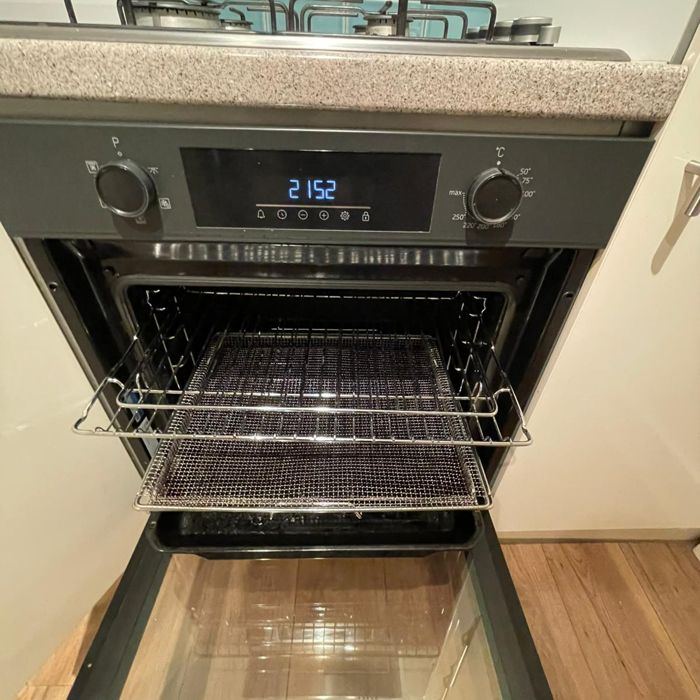
This method is for standard enamel interiors only.
You do not need to add vinegar. Vinegar and bicarbonate of soda react and largely cancel each other out, so the fizz adds very little. It is also an acid, and any acid must be kept away from natural stone worktops, grout and unsealed surfaces.
Run the oven for a short time once it is fully dry, and check for any lingering smell before you cook.
Burnt-on grease needs time to soften. Forcing it with a metal tool risks damaging the lining.
The door glass is often what people notice first, and it is easy to damage. Avoid metal scrapers, wire wool and abrasive powders, because they can scratch the glass.
Clean the glass with hot soapy water and a non-scratch sponge. For browned-on marks, apply the bicarbonate paste, leave it for a while, then wipe it away with a damp cloth. Some doors come apart for cleaning between the panes, but only attempt this if your manual explains how to do it. Wipe the rubber seal gently, and do not pull it out or soak it.
Treat chemical oven cleaner as the last resort. Many are strongly alkaline, and they can cause burns to skin and eyes.
If you do use one, read the whole label first, as products differ in how they should be used. Then:
Never mix oven cleaner with other cleaning products. Rinse away one product completely before you use another.
Some ovens are beyond what a home clean can comfortably manage, particularly when grease has carbonised over several years. It is also worth getting help if you are preparing for guests, or a move out, and would rather spend the time elsewhere.
Inside the oven can be added to a one-off, fortnightly or deep clean, and it is already included in our end of tenancy cleans. You can see how each option works on our pricing page.
If your oven needs attention before the festive season, send us the make and model with a photograph, and we will tell you what we can do.
Need a hand?
Family-owned, fully insured and worked to a written checklist. We reply within the hour, 8am to 8pm.
Keep reading

How to clean a fridge safely before the Christmas food shop, from glass shelves and door seals to the drain hole, plus when to defrost the freezer.
Read more →
Why mould and condensation appear in winter, how to clean small patches safely, and practical ways to reduce moisture in your London home.
Read more →
How to remove limescale safely from bathroom taps, shower heads, glass and tiles, and the surfaces where an acid descaler must never be used.
Read more →Our services

One-off and regular cleaning, worked to a checklist agreed with you.
Explore service home cleaning
Weekly or fortnightly visits, the same standard every time.
Explore service recurring cleaning
For homes that need recovering, not just tidying.
Explore service heavy-duty deep cleaning
Empty homes cleaned for moving out or moving in, worked to the check-in report.
Explore service end of tenancy and move in / move out cleaning
Staged cleaning that removes the dust builders leave behind.
Explore service after builders cleaning
Hotel-standard changeovers between guests.
Explore service short-let and airbnb cleaning
Offices and workplaces, cleaned out of hours.
Explore service commercial and office cleaning
Kitchens and dining rooms, cleaned after service.
Explore service restaurant cleaning


Ready across Central and West London.
Request your fixed price
Welcome to Elevated Polished Cleaning, a family-owned, fully insured cleaning company looking after homes and businesses across Central and West London.
Fill in the form below to book your next clean. We reply within the hour, 8am to 8pm, with a fixed price.
Join the families across Central and West London who trust us with their weekly clean.